
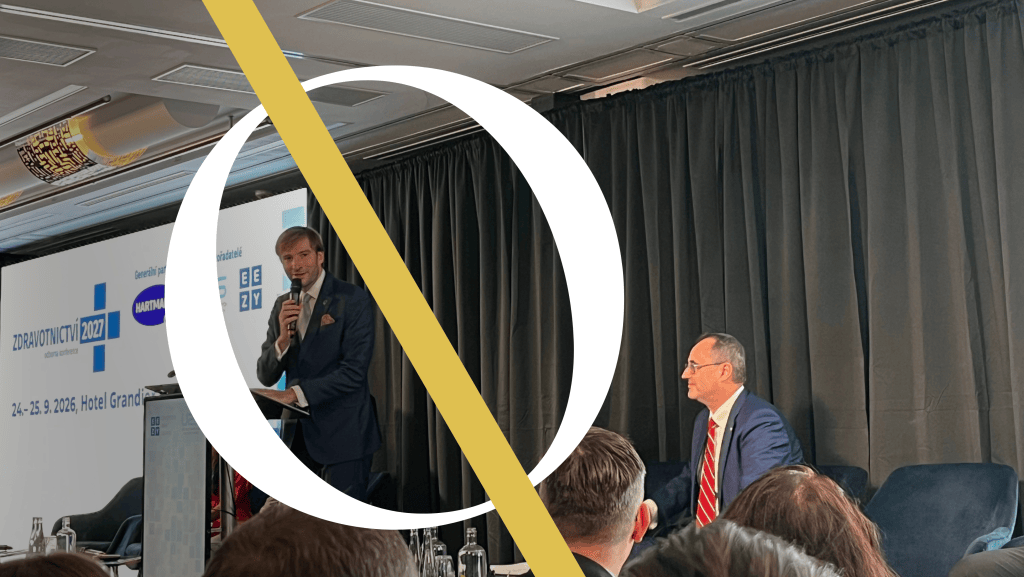
On September 24th and 25th, the 12th incarnation of Czechia’s largest annual healthcare industry conference Healthcare 2027 took place
Of the 4 Czech government cabinet members scheduled, only 2 showed up, but those who did were the Health Minister Adam Vojtěch and Sport & Prevention Minister Boris Šťastný. Their opening addresses to the conference-goers revealed important insights into what the government sees as cardinal concerns not just in the area of general healthcare, but more holistically as overall concerns for demographic development of the country.
And they are right to sound the alarm on these issues. The issues outlined as the government’s focus are in no way exclusive to Czechia, or even special in any way. In the last decade, these topics have gone from expert predictions to warnings to policy points.
Let us go through each of the key points outlined by them and how will the measures they propose impact companies not just in Czechia, but in Europe more broadly.
Population Ageing & Prevention Economics
The radical increase in the rate in which a country’s population average age increases has been the overall throughline which Minister Vojtěch introduced as the key reason for the decisions outlined later on. The message is simple – if the costs of healthcare services for seniors remain as they are, we may not know how to finance healthcare in 10 years.
This message echoes through much of the developed world, and hits harder for countries whose healthcare system doesn’t have the relatively robust and professional reputation of the Czech Republic. Japan has the oldest population in the world. The UK and Ireland have seen the evidence of population ageing to the backdrop of healthcare systems that seriously strain to service the population as it is.
The Czech government seems to have decided to follow the Japanese model in proposed solutions. Japan has a history of being a remarkably early adopter of a prevention-first healthcare model. The theory is that the government can cover the financial strain of an ageing population on the healthcare system if the population is healthier and therefore doesn’t use it as often as it otherwise would.
A McKinsey & Company report from 2022 has placed the ROI on every Euro invested in preventative care to the rate of 1:1,3. A report made in 2025 by the healthcare industry platform of the German state of Baden-Württemberg places the rate at 1:2,2. In 2026, the Czech Minister of Health stated it is 1:3 or 1:4. And there are reports circulating around the industry that place the increasing return on prevention investment much higher.
Costs of Public Healthcare and Efforts to Rationalise It
Minister Šťastný, into whose portfolio prevention falls, stated in his speech that the healthcare system has seen the most generous funding in history, circa 25 billion €. And yet, the discussion revolved around where money could be saved. Clearly, the political signal is that however much money is funneled into the healthcare system, it will not be tenable either way.
Clearly, the issue is that the healthcare has high operational costs rather than it being chronically underfunded. And so, one of the main topics of the conference was how to incentivise savings across the board by all important actors in the healthcare industry – the government, insurers, hospitals and patients.
The Ministry of Health seems to be committed to move away from any notion of an NHS-like centralised system and make it being driven by direct market competition between insurance providers instead.
The insurers, who were asked by speakers from both the political and the hospital side to take on a more active role in financing the system, saw their role as being those who incentivise patients to save the system later expense by going to prevention check-ups. Ideation on these incentives noted schemes to lower the mandatory monthly insurance fee that all Czech citizens have to pay, or cashback programs for those who meet their annual prevention check-up targets.
Ongoing Digitalisation of the Healthcare System
The government is trying to find savings in operational procedures and sees the greatest value in potential savings on overhead. Both Ministers outlined their respective attempts at digitalisation of various areas of healthcare – from digital prescriptions, a country-wide patient record database and centralisation of regional health institutes – a system which has been in place since the first half of the 20th century.
The overall throughline of non-preventative savings topics was the increase of the healthcare system’s efficiency by eliminating the likelihood of human error by employing an interconnected ecosystem of digital solutions that would prevent misinterpretation of medical data by doctors and patients.
Stakeholders of hospitals circled back to efficiency. Czech healthcare system boasts a large number of overfunded and underutilised emergency beds, as well as ageing technology that, likewise, is scarcely used. The concept of Health Technology Assessment came up more than once. Hospitals are encouraged to review their capacities and hardware and correlate it to the data from their daily operations. There is a push towards evidence-based healthcare.
While members of the panel of government and medical decision makers discussed these efficiency-improvement concepts, a pharmacist from the audience stood up to comment that despite these lofty ideas, in practice, pharmacists and medical practitioners still aren’t coordinated and don’t automatically share all patient records because they simply lack the government approved tools and until that changes, those ideas aren’t able to be put into practice.
Impacts on the Commercial Sector
The policy signals emerging from this conference highlight clear implications for the business sector. Opportunities for providers of several categories of products and services stand out as notable: Operational & Digital Transformation, Diagnostics, and Data Analytics.
With population ageing framed as a binding fiscal constraint, the government’s emphasis on prevention economics creates preferential demand for pharmaceutical and biotech firms whose portfolios centre on vaccines, screening technologies, chronic-disease treatments and digital therapeutics that can demonstrably lower long-term utilisation rates.
Medical-device and diagnostics companies offering tools that support early detection or risk reduction are similarly well placed, as are providers of adherence programmes, remote-monitoring solutions and risk-stratification platforms that enable insurers to design and administer patient incentives.
Hospital efficiency being an increasigly important topic may lead to greater scrutiny on medical equipment procurement if hospitals more strictly review business cases for new investments and employ the HTA on high-cost acute or late-stage therapy equipment, while rewarding those manufacturers and service providers able to furnish robust real-world evidence of total cost-of-care reductions.
Therefore, a rising interest in operational and digital transformation projects from hospitals and medical centres is predictable, as well as in enabler services for such projects, such as vendors of data analytics services with the end goal of increased and more efficient coordination and interoperability between all participants of the healthcare system.
A concluding note: While the intentions of policy makers are sufficiently clear, a similarly clear hurdle was mentioned many times – the political process is slow and inefficient itself. And while the demographic pressure is relentless and its impacts are largely unavoidable, it is still unclear if the proposed policy measures will be implemented fast enough before those impacts catch up.

David Vavruška
Partner and Operations Lead
(+420) 774 134 744 | david.vavruska@orrery.cz

