

EU pushes its businesses towards a more extensive and responsible due diligence practice
The European Union’s regulatory architecture for sustainable value chains continues to mature through a combination of horizontal due diligence obligations and targeted product-focused instruments. For EU companies, the EU Deforestation Regulation (EUDR), the Packaging and Packaging Waste Regulation (PPWR) and the Forced Labour Regulation (FLR) impose concrete market-access and operational requirements that intersect with, and in many cases operationalise, the broader due diligence framework established by the Corporate Sustainability Due Diligence Directive (CSDDD).
In this insight, we aim to outline the core mandated requirements of each instrument, their timelines and their interplay with the upcoming CSDDD.
Companies that treat these regimes as low priority compliance exercises risk not just inefficiency and residual exposure, but straight-up market bans, shipments of critical goods seized at the border and hefty Union fines. Those that integrate them into a coherent due-diligence operating model will be better positioned to manage risk, secure market access and demonstrate responsible conduct.
The CSDDD – EU’s envisioned horizontal backbone for supply chain visibility
The European Union’s regulatory architecture for sustainable value chains continues to mature through a combination of horizontal due diligence obligations and targeted product-focused instruments. For EU companies, the EU Deforestation Regulation (EUDR), the Packaging and Packaging Waste Regulation (PPWR) and the Forced Labour Regulation (FLR) impose concrete market-access and operational requirements that intersect with, and in many cases operationalise, the broader due diligence framework established by the Corporate Sustainability Due DiliThe Corporate Sustainability Due Diligence Directive, (EU 2024/1760), also known as the CSDDD, mandates that EU companies in its scope are obligated to proactively seek out segments of their supply chains where actual or suspected violations of human rights and environmental law. These could be caused by their own activites, or by activities of its subsidiaries, suppliers or other business partners.
Following its 2025 and 2026 amendments, the Directive applies to EU companies with more than 5 000 employees and a net worldwide turnover exceeding EUR 1.5 billion, and to non-EU companies generating more than EUR 1.5 billion net turnover in the Union. Member States must transpose the amended rules by 26 July 2028, and the obligations to businesses begin to apply from 26 July 2029.
Failing to comply with the CSDDD can result in a fine of up to 3 % of net worldwide turnover.
Most importantly for the year 2026, however, it creates an overarching process obligation within which the more granular rules of more specialised regulations can be applied – specifically those of EUDR, PPWR and FLR.

EU Deforestation Regulation
The European Union’s regulatory architecture for sustainable value chains continues to mature through a combination of horizontal due diligence obligations and targeted product-focused instruments. For EU companies, the EU Deforestation Regulation (EUDR), the Packaging and Packaging Waste Regulation (PPWR) and the Forced Labour Regulation (FLR) impose concrete market-access and operational requirements that intersect with, and in many cases operationalise, the broader due diligence framework established by the Corporate Sustainability Due DiligThe EUDR prohibits companies from placing cattle, cocoa, coffee, palm oil, rubber, soya, wood and some of their derived products on the EU common market if those products aren’t deforestation-free.
Deforestation-free in this context means, that they weren’t produced on land that was subject to deforestation after December 2020. Furthermore, the products must have been produced in accordance with the relevant legislation of the country of production, and must be covered by a due-diligence statement submitted via the EUDR information system.
Main obligations for companies begin to apply from 30th December 2026 for large and medium-sized businesses (and for micro and small businesses already covered by the former EU Timber Regulation) and from 30 June 2027 for other micro and small enterprises. The EUDR underwent a simplification in 2024–2025, which, as the European Commission projects, will reduce annual compliance costs for companies by approximately 75 % compared to the original framework.
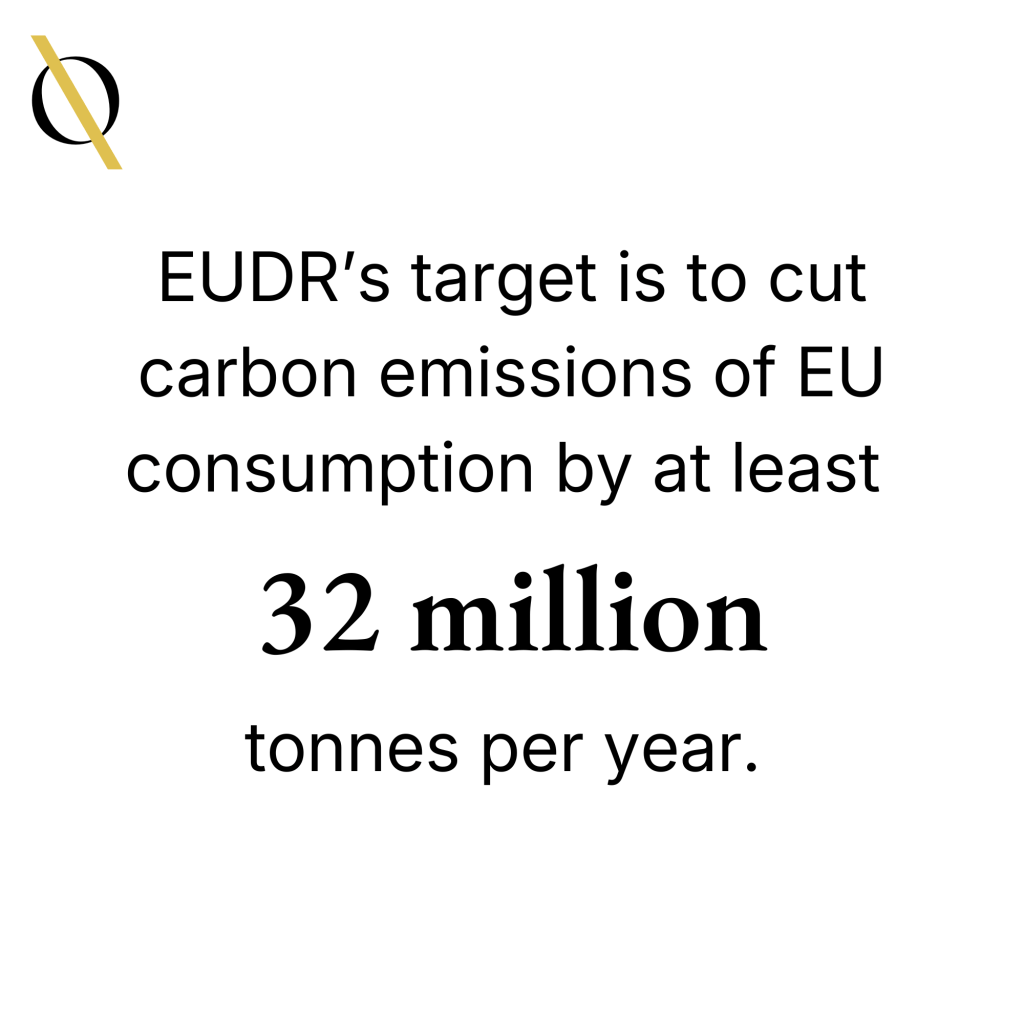
The stated goal of EUDR is designed to cut carbon emissions linked to EU consumption and production of the covered commodities by at least 32 million tonnes per year. Still, EUDR is not without exemptions in places where the EU feels strict control could significantly damage EU’s industrial interests. Pharmaceutical companies, for example, are exempt from compliance when it comes to palm oil products used in the manufacturing of drugs.
For companies within CSDDD scope, the EUDR supplies a concrete, commodity-specific expression of the environmental due-diligence duty, particularly with respect to land-use change and biodiversity impacts. Traceability systems, geolocation data and risk assessments developed for EUDR purposes will form natural inputs into the broader CSDDD impact-assessment process.
Packaging and Packaging Waste Regulation
The PPWR aims to create a single, Union-wide set of rules for the entire life-cycle of all packaging placed on the Union market, irrespective of material or origin. It sets requirements for what the packaging itself should fulfill (including packaging recyclability in an economically viable manner, minimum recycled content for plastic packaging, and redesigning packaging to minimise its size and volume), obligations when it comes to labelling, extended producer responsibility, and targets for waste-prevention.
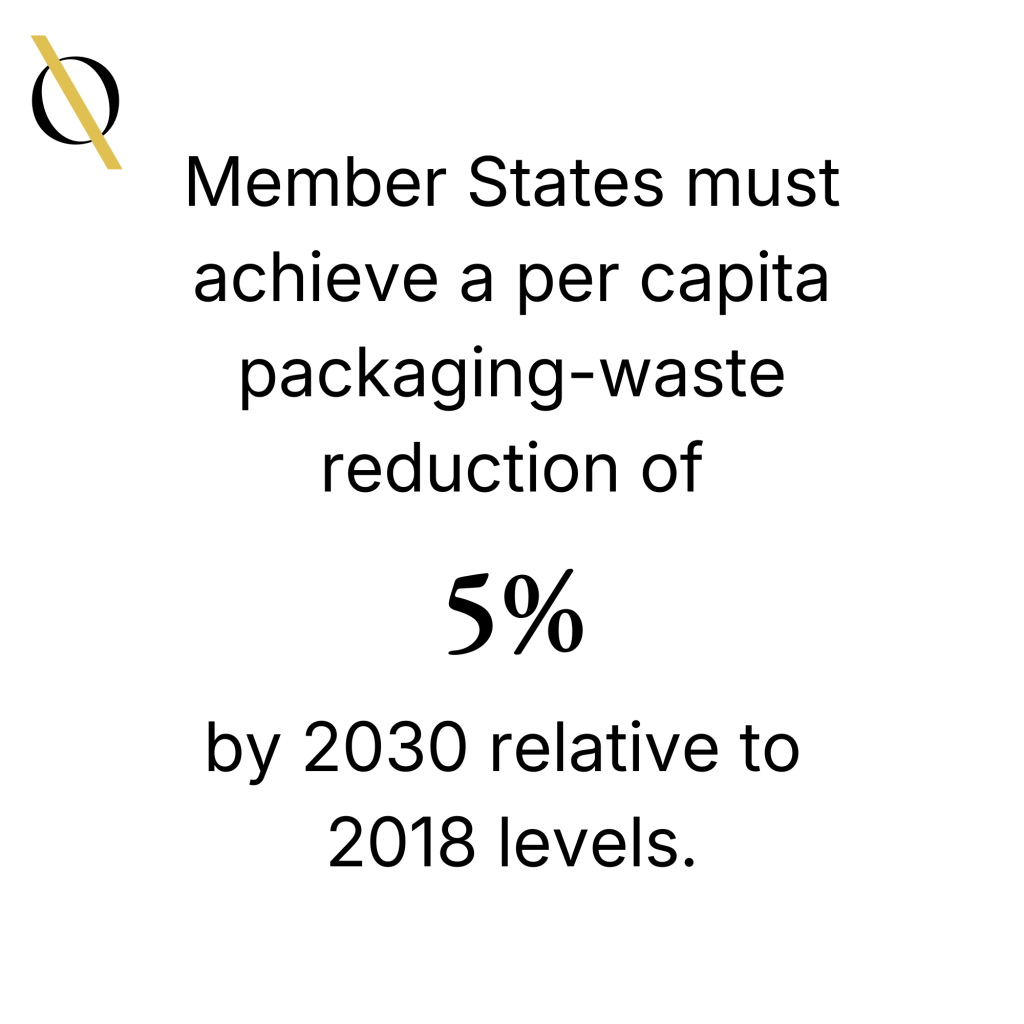
By 2030, EU’s member states are expected to have reduced packaging waste per capita by 5%, increasing to 10% by 2035, and 15% by 2040 compared to 2018 per capita levels. Overall recycling targets rise to 65 % by 2025 and 70 % by 2030, with material-specific targets.
The Regulation itself entered into force on 11 February 2025, but its obligations (including its restrictions on the so-called “forever chemicals” or PFAS in food-contact packaging) apply to companies from its general application date of 12 August 2026. Further design-for-recycling, reuse and recycled-content obligations phase in from 2030.
Within a CSDDD framework, PPWR compliance addresses environmental impacts associated with resource use, waste generation and pollution. Design choices, recycled-content targets and EPR schemes constitute practical measures that companies can demonstrate as part of their prevention and mitigation actions under the Directive.
Forced Labour Regulation
The FLR, refreshingly simply, prohibits businesses from placing any products that were made with forced labour (including child labour) on the market of the European Union.
The prohibition covers all products, irrespective of origin, sector or stage of the value chain, and applies to all economic operators that place any products on the market or export them. Unlike the other regulations mentioned in this insight, it does not impose additional mandatory due-diligence obligations beyond those already existing under Union or national law, but recognises due diligence as a useful tool for preventing downstream issues with the law.
The Regulation applies from 14th December 2027, but member state governments are supposed to have FLR penalty systems ready by 14th December 2026. In practice, it is expected that competent EU and national authorities will conduct risk-based investigations and inspections of businesses they suspect of breaching this regulation.
Companies will be asked to disprove all suspicions within relatively short deadlines (30 days) and therefore, it is recommended that companies proactively track suspected violations within their supply chains and be prepared for unexpected cooperation with the authorities. Products found to have been made with forced labour may be prohibited and withdrawn.
For CSDDD-covered companies, the FLR crystallises the human-rights dimension of due diligence with respect to forced labour. Information and systems developed to identify and address forced-labour risks under the Directive will be directly relevant to demonstrating that products are not made with forced labour, and will be the type of material authorities are likely to request in any investigation.
Strategic implications of the push for due diligence and supply chain visibility
These three product-specific regulations create overlapping, parallel but distinct demands on data, systems and governance:
- Human-rights risk management under CSDDD provides the process backbone for FLR compliance, while environmental risk management supports both EUDR and PPWR.
- Traceability and supply-chain visibility are central to EUDR (geolocation and production data) and highly relevant to both FLR investigations and CSDDD impact mapping.
- Product design and material choices are governed by PPWR and feed into environmental-impact assessments under CSDDD.
Companies already preparing for CSDDD application in 2029 should therefore map the earlier application dates of the PPWR (August 2026), EUDR (December 2026 / June 2027) and FLR (December 2027) onto their due-diligence roadmaps. Their compliance priorities should be:
- Establishing or enhancing end-to-end traceability systems capable of supporting geolocation, legality and forced-labour risk assessments.
- Integrating packaging design, recycled-content and EPR obligations into product-development and procurement processes.
- Aligning risk-prioritisation methodologies so that commodity-specific (EUDR), material-specific (PPWR) and labour-related (FLR) risks are assessed consistently within the CSDDD framework.
- Preparing documentation and due-diligence statements that can serve multiple regulatory purposes, thereby reducing duplication of data and work.
The Commission has issued, or is mandated to issue, guidance documents for each instrument. Companies should monitor these closely, as they will shape both national enforcement and the practical interpretation of CSDDD obligations.
In conclusion, EUDR, PPWR and FLR all translate the high-level due-diligence duties of the CSDDD into concrete, enforceable market rules with delayed but soon approaching application dates.
For EU companies, the strategic imperative is integration: treating the product-specific regimes not as isolated compliance workstreams but as operational expressions of the same underlying responsibility to identify, prevent and address adverse impacts.
Those businesses that manage to build coherent systems now will reduce compliance cost, strengthen resilience and position themselves to meet the full CSDDD obligations when they become applicable in 2029.

David Vavruška
Partner and Operations Lead
(+420) 774 134 744 | david.vavruska@orrery.cz
 Orrery Consulting